

Widevine, a DRM-based digital rights management solution led by Google, commands over 70% of the global market share. It supports mainstream devices including Android smartphones, smart TVs, in-car systems, and set-top boxes, and serves as the mandatory HD content playback standard for global platforms such as Netflix, Disney+, and YouTube.

1、Widevine: The "Security Checkpoint" of Streaming Media
Widevine's primary function is to encrypt and protect streaming audio and video content, preventing unauthorized copying, piracy, and tampering.
l For users: determines the maximum resolution your device can display.
l For manufacturers: This constitutes a mandatory entry barrier for the global premium streaming market. Without certification, even devices supporting 8K resolution can only play standard definition content.
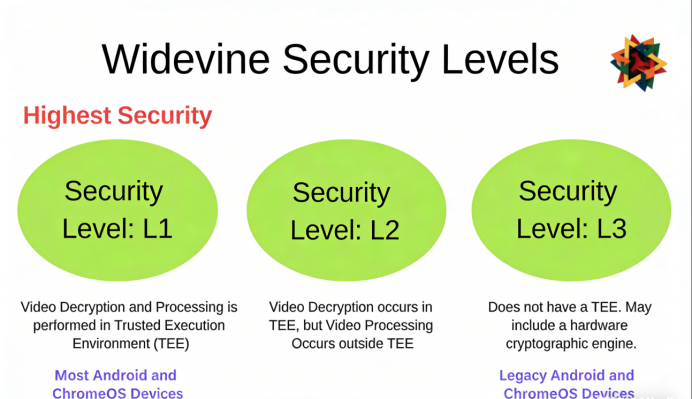
Widevine classifies security levels into three tiers, with higher tiers offering superior image quality and enhanced anti-theft capabilities.
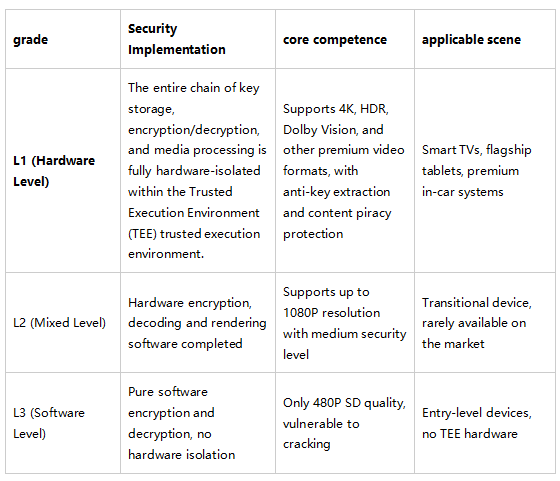
For device manufacturers, L1 certification serves as a mandatory requirement for entering the premium streaming media market. Without this certification, even hardware supporting 8K resolution can only play standard-definition content.
2、L1 Authentication Process and Key Steps
L1 certification is a comprehensive compliance process covering hardware, software, production lines, and testing. The standard cycle duration ranges from 8 to 15 weeks, requiring strict adherence to Google specifications with no steps allowed to be skipped.
1. Submit device information
l Submit an application to Google, sign the Widevine MLA agreement, and commit to complying with copyright protection and security regulations.
l Complete the device survey questionnaire and provide detailed device parameters (hardware, operating system, DRM integration method, etc.).
l Chip prequalification requirements: The main control chip must be included in Google's whitelist, feature built-in Trusted Execution Environment (TEE) or a dedicated security unit, and support OEM Crypto API.
Note: Procedures and fees vary depending on device characteristics and require prior evaluation.
2. Preparation of testing equipment
lZhongle Certification can assist in completing the configuration of test equipment entry.
lOEMs (Original Equipment Manufacturers) obtain test guidelines and required tools.
3. Code integration and pre-testing (2–3 weeks)
lOEMs must conduct all required compatibility and security testing on the devices.
lAfter passing the testing, the device will be delivered to the certification testing laboratory.
4. Third-party authoritative testing (1–2 weeks)
l Submit samples to Google Labs for comprehensive compliance testing;
l Failure to pass testing requires rectification and retesting, which directly impacts the overall cycle.
5. Google approval and Keybox issuance (4–6 weeks)
l The Google Lab test report has been submitted to Google for final review.
l After approval, the unique device key Keybox is issued to complete authentication, enabling mass production and deployment of the device.
3、Core authentication test content
Certification is not merely about 'video playback capability,' but involves comprehensive security and compatibility validation across all scenarios. The core testing includes four categories:
1. CTS Compatibility Testing (Android-exclusive)
The verification system maintains its underlying architecture integrity, strictly adhering to Google's CDD specifications to ensure stable operation of the DRM framework.
2.CDM unit test
Core module validation: Keys must not be leaked into regular memory, encryption/decryption processes must comply with regulations, and chip manufacturers must provide dedicated debugging tools.
3.WVTS Test Kit
In complex scenarios such as simulated calls, background switching, and network disconnection/reconnection, the DRM protection remains effective without degradation.
4. HDCP 2.2 Verification
Transmission link mandatory requirements: HDCP 2.2 is not supported, and 4K content cannot be played even through Layer 1 (L1) protocols, ensuring end-to-end encrypted transmission. The 'Software and Hardware Resource Constraint Table' serves as a critical self-check document prior to certification. Version V6.0.0 introduces more stringent requirements for this table, and partners are advised to thoroughly verify it before submission to ensure hardware resources comply with V6.0.0 constraints.
4、Hard requirements for L1 certification
1. Hardware-level requirements (non-negotiable)
l The chip must incorporate either a Trusted Execution Environment (TEE) or an independent security unit, with hardware-level key isolation support.
l The chip must be included in Google's whitelist and implement compliant OEM Crypto APIs. If the underlying architecture does not support these requirements, it cannot pass the L1 certification.
2. System Safe Boot Requirements
l Establish a complete trust chain starting from the bootloader, with each boot image requiring signature verification.
l Devices supporting bootloader unlocking require a keybox auto-clear mechanism to prevent piracy and misuse.
3. Factory production line requirements (most common pitfalls)
l Keyboxes must be manufactured on enclosed secure production lines using dedicated encryption devices for burning, and operations in open network environments are strictly prohibited.
l The key is uniquely linked to the device hardware and can only be burned once. It cannot be reissued or modified via OTA updates later.
4. Key differences in system platforms
l Android devices: Leveraging native ExoPlayer with low integration complexity, prioritizing compatibility with TEE and OEM Crypto.
l Linux-based devices (set-top boxes, in-car systems): Lacking native player frameworks, developers must create custom players supporting DASH streaming, CDM integration, and license requests, requiring more advanced technical expertise.
5、Zhongle Certification: FAQs and Pitfall Avoidance Recommendations
1. Cycle: Standard duration of 8–15 weeks, influenced by self-assessment, 3PL retesting, and Google review.
2. High-frequency Pitfall Identification and Avoidance Recommendations
l Cycle delay: Inadequate pre-testing leads to retesting. It is recommended to conduct comprehensive self-testing before sample submission.
l Chip incompatibility: Verify the chip's inclusion in the whitelist prior to project initiation, and proactively coordinate with the chip supplier to obtain support documentation.
l Production line violation: Keybox burning environment is unsafe. Authentication is revoked immediately.
l HDCP omission: Synchronization adaptation for HDCP 2.2 to prevent L1 from passing through without 4K capability.
l Linux system adaptation is slow: Plan player development in advance and allocate sufficient debugging time.
6. Summary
Widevine certification goes beyond mere "video streaming capability," serving as a comprehensive validation of hardware security, software architecture, and production compliance. Zhongle Certification assists manufacturers in synchronizing certification planning during project initiation while strictly adhering to Google's processes. This approach significantly reduces risks, shortens timelines, and ultimately enables devices to legally access HD content, enhancing user experience and commercial value.
For further information, please feel free to contact us.
Tel: 13417442373(Wechat)
E-mail: finny.zhou@zhongletest.com
Teams:nancy.le@zhongletest.com