


In 2026, the Android Auto certification framework underwent a comprehensive version upgrade; however, the actual changes were far more complex than the simple statement "Version 2.0 replaces Version 1.0."
On the surface, the AA 2.0 update modifies the certification process and requirements. However, upon closer examination at the implementation level, it becomes clear that the actual barriers posed by the rule restructuring have actually increased rather than decreased: the surge in the number of test cases, the overall increase in the weight assigned to voice testing, and the growing demand for multi-screen and vehicle control integration have elevated the engineering complexity of this certification round significantly compared to the AA 1.0 era.
Ⅰ. Balancing burden reduction with additional requirements: The "invisible barrier" of AA 2.0 is embedded within the testing process.
On January 9, 2026, Google officially closed the AA 1.0 submission portal; all new projects must now follow the 2.0 submission pathway, and results from the 1.0 testing phase cannot be transferred. The 2.0 process has been streamlined: the annual ID renewal requirement has been removed; the compliance exception approval process has been upgraded to "Family remains valid for the entire platform lifecycle"; and SSL certificates can now be obtained in advance during the development phase.
However, the increased testing complexity negates these conveniences. The AA 2.0 test suite contains nearly half as many test cases as the AA 1.0 version; moreover, three metrics—Qsuite performance, Plugbot stability, and VRRT voice testing—carry extremely high weight. The test evaluation process is fully automated, meaning the quality of the self-tests directly determines the success or failure of the project. Additionally, project teams are required to submit a complete BOM, hardware schematic diagram, and version difference comparison table in advance for review; requirements such as USB-C PD power negotiation, data role switching, OTG compatibility, as well as the Wi-Fi Direct handshake timing and 5 GHz frequency band priority for wireless solutions, all serve as mandatory prerequisites for the preliminary document review process.
II. From Screen Mirroring to Vehicle Control: PDK 6.0 is redefining the capabilities of Android Auto.
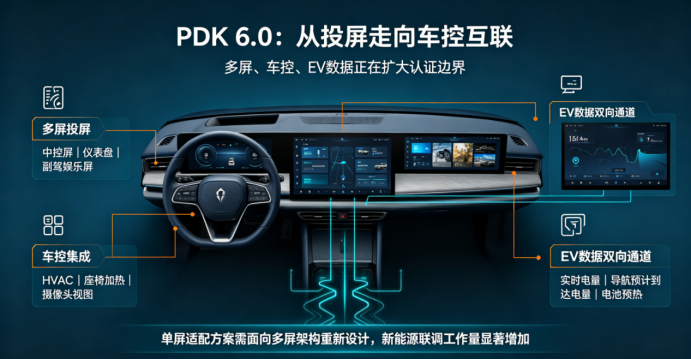
In August 2026, Google officially launched PDK 6.0. Unlike PDK 5.0, which focused on encoding and connectivity stability, PDK 6.0 shifts its emphasis toward expanding functional boundaries.
Multi-screen mirroring represents one of the most significant changes. Android Auto can now display different content simultaneously on the central control screen, the instrument cluster, and the passenger entertainment screen; as a result, the single-screen adaptation testing approach needs to be completely revamped for the multi-screen architecture. Vehicle function integration allows features such as HVAC, seat heating, and camera views to be integrated into the Android Auto interface – the boundary between the in-vehicle system and Android Auto is gradually blurring, and the scope of certification testing has consequently expanded.
Furthermore, PDK 6.0 enhances the bidirectional EV data communication channel – features such as real-time battery level monitoring, estimated battery level based on navigation arrival times, and automatic battery preheating are now integrated into the system – which significantly increases the joint debugging workload for new energy vehicle models.
III. Version Window Countdown: Versions 4.3 and earlier have been completely phased out; for new projects, there is no longer any choice.
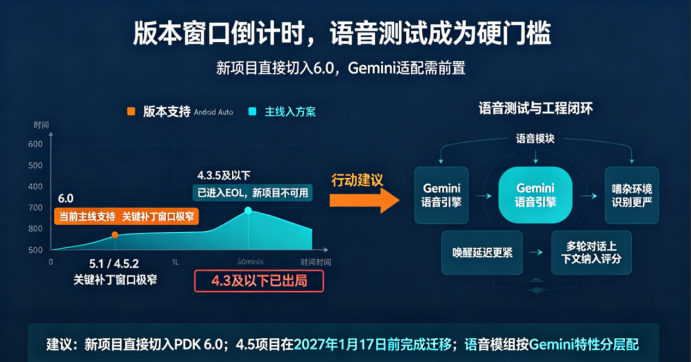
According to Google's official support timeline, version 6.0 is currently the only version still within the active support window. The critical patch release dates for versions 5.1 and 4.5.2 have been set for July 8, 2026 – a very narrow support window – while all versions starting from 4.3.5 and earlier have reached End of Life (EOL); these versions can no longer be used in new projects.
This is not a "recommended upgrade" but a mandatory rule. Google explicitly states that partners may not use unsupported versions that have reached End of Life (EOL) when submitting a Green Light request, unless they have obtained written approval. In other words, for teams that are still planning to apply for certification on PDK 4.3 or earlier platforms, the certification channel has been closed – meaning they cannot submit a request at all, rather than simply waiting to see if the version is still supported. The same applies to PDK 4.2.5 and PDK 4.1.4: support for these versions has long been discontinued, and no new certification requests can be approved.
For teams that have not yet initiated the certification process, migrating directly to version 6.0 is the only practical option. Projects still running on the version 4.5 platform must complete their version migration by January 17,2027; otherwise, they will face the same risk of being phased out.
IV. Gemini Integration: Voice Testing Evolves from a "Bonus Feature" to a "Hard Threshold"
Another significant change in 2026 is the increased weighting given to the Gemini voice assistant in the certification process. Starting in 2025, Google will switch the default voice engine for Android Auto in overseas English-speaking markets from Assistant to Gemini; accordingly, the evaluation criteria for the VRRT voice testing have been updated: the wake-up latency threshold has been tightened, the accuracy requirement for recognizing noisy environments has been raised, and multi-turn dialogue context understanding has been incorporated into the scoring system.
This has a particularly significant impact on domestic manufacturers – the coverage of the Chinese language corpus and the depth of localization optimization in Gemini differ from those of its English version; therefore, simply submitting the voice module – which was optimized during the Assistant era – for testing is unlikely to pass. Instead, layered adaptation tailored to Gemini's speech recognition capabilities should be implemented during the development phase, rather than making last-minute adjustments just before submission for testing.
V. Rule Interpretation and Process Management: The Tacit Competitiveness of the 2.0 Era
Android Auto 2.0 simplifies the user experience on the surface, but in essence represents an implicit enhancement of corporate compliance capabilities – testing not only product performance but also an organization's understanding of regulatory requirements, mastery of operational workflows, and professional expertise in engaging with Google. With years of experience in automotive connectivity certification, Zhongle Certification has assisted hundreds of enterprises in efficiently obtaining various international automotive certification programs. For the new Android Auto 2.0 regulations, we provide end-to-end services spanning document pre-review, test tracking, and corrective action communication, helping businesses secure their certifications in the shortest possible timeframe and at the lowest possible cost.
Tel: 13417442373(Wechat)
E-mail: finny.zhou@zhongletest.com
Teams:nancy.le@zhongletest.com