


Whether the battery life is reliable, when recharging is needed, and approximately how long the charging process takes, remain the three primary concerns for electric vehicle users.
Unlike internal combustion engine vehicles, the driving range of an electric vehicle is not a fixed value. Various factors—such as driving speed, road gradient, ambient temperature, air conditioning operating conditions, and battery temperature—can significantly impact actual energy consumption. If a navigation system relies solely on the vehicle's remaining battery charge to make judgments, it will struggle to provide reliable predictions of remaining battery life and appropriate charging strategies.
Google's VEM (Vehicle Energy Model), introduced within the Android Auto ecosystem, was specifically designed to address this issue.

I. What is VEM?
VEM is a set of models developed by Google Maps to predict the energy consumption of electric vehicles.
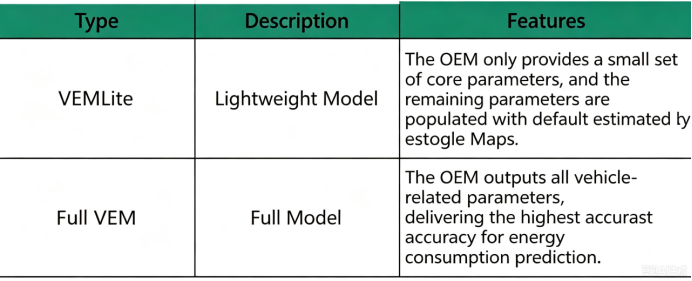
It is provided to the navigation app on Android Auto via the vehicle infotainment system (HU) using the Google Automotive Link (GAL) protocol. Depending on the completeness of the data provided by the vehicle manufacturer, VEM can be categorized into two types:
Ⅱ.VEM's Three Core Capabilities
Focusing on electric vehicle mobility scenarios, VEM has established three core predictive capabilities:
1. Route energy consumption prediction
Calculate the total energy consumption of the entire driving route, encompassing both the energy consumed by the vehicle's propulsion system and the power consumption of auxiliary equipment such as the air conditioning system and onboard electronic devices.
2. Charging time estimation
Estimate the required charging time based on the vehicle's charging performance and the charging curves under different battery states.
3. Battery Preheating Modeling
The energy loss generated during the simulated battery heating process is used to estimate the real-time temperature of the battery; these temperature results, in turn, are utilized to calculate the charging duration.
Total energy consumption = route energy consumption + battery preheating energy consumption
Ⅲ.Why is VEM indispensable?
Many people hold a common misconception: that knowing the vehicle's current remaining battery level is sufficient to determine whether it can reach its destination; however, this is not the case in reality.
Constrained by thermal losses during combustion, the overall efficiency of internal combustion engine vehicles typically ranges between 20% and 25%, resulting in relatively stable energy consumption performance. In contrast, electric vehicle motors can achieve efficiencies of 70%–95%, with inherently low baseline losses; however, the overall energy consumption of electric vehicles is highly susceptible to interference from external environmental conditions and road characteristics. The primary influencing factors include:
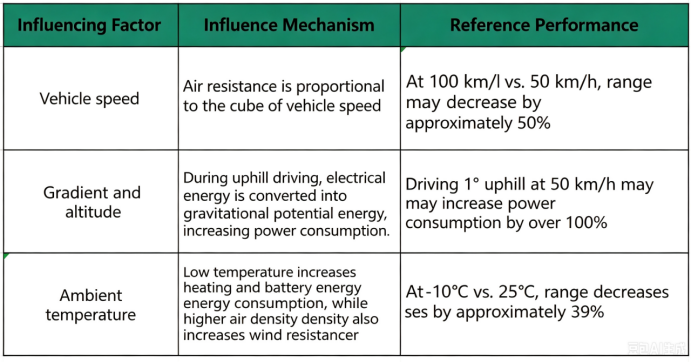
Multiple factors can cumulatively affect the battery life throughout the journey; relying solely on the remaining battery level at the time of departure makes it difficult to accurately predict the battery level upon arrival.
The value of VEM lies in making the vehicle's hardware characteristics—such as road load factor, power and energy recovery efficiency, auxiliary equipment power consumption, and charging curves—available to Google Maps. The navigation software can then calculate the net change in energy consumption during the journey in segments, delivering more accurate battery life predictions and charging plans that better reflect real-world conditions.
Ⅳ.Practical navigation features supported by VEM
Once connected to VEM, the electric vehicle navigation system can leverage a variety of practical features:
1. Remaining battery power prediction: Estimate the remaining battery power after arriving at the destination or passing through intermediate points.
2. Intelligent charging planning: Automatically calculates your trip and recommends necessary charging stations along the way.
3. Vehicle Energy Prediction API: Provides detailed energy consumption prediction data for individual routes to external systems.
4. Battery-linked preheating: The navigation system identifies the destination and charging stations, then notifies the vehicle to adjust the battery temperature in advance.
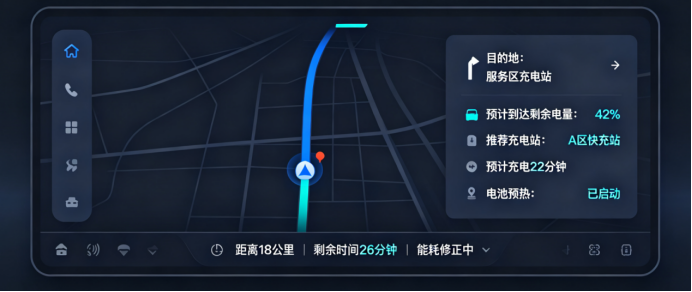
Google Maps integrates route distance, estimated driving speed, elevation changes, ambient temperature, and points to segment the entire route into multiple smaller segments, calculating energy consumption for each segment individually, and then aggregating these results to determine the net change in battery charge over the entire journey. During the trip, the system updates its calculation results every minute, while simultaneously applying iterative corrections based on the driver's actual driving efficiency.
Ⅴ.The practical value to automakers
Automotive manufacturers can implement VEM in phases rather than requiring full deployment at once:
Initial phase: Use the lightweight VEMLite model to quickly complete basic integration;
Advanced stage: Upgrade to the Full VEM complete model to further enhance the accuracy of energy consumption prediction;
Certification phase: Use the Google toolchain to complete functional validation and official certification.
Ⅵ.sum up
VEM is not merely a simple on-board battery level display tool; it also serves as the energy calculation engine powering intelligent navigation for electric vehicles. It enables navigation systems to go beyond simply answering "How much battery power does the vehicle currently have?" to perform a range of critical assessments:
1) How much battery power will remain after arriving at the destination?
2) Is it necessary to schedule a charging stop during long-distance travel?
3) How long is the estimated time required for site power supplementation?
4) Is it necessary to pre-heat the battery in advance?
As the market penetration rate of electric vehicles continues to rise, driving range and charging experience are becoming key criteria for users to evaluate the overall vehicle experience. The transformation brought by VEM is advancing navigation from simple route guidance to an integrated travel planning solution that combines route optimization with energy management.
For automakers, understanding and implementing VEM integration as early as possible can not only optimize the navigation user experience but also help them establish a distinct competitive advantage in the realm of intelligent vehicle technologies.
Zhongle Certification specializes in certification services for intelligent connected vehicles and in-vehicle systems. If you require assistance with VEM integration, commissioning, or certification support, please feel free to contact us.
Tel: 13417442373(Wechat)
E-mail: finny.zhou@zhongletest.com
Teams:nancy.le@zhongletest.com