

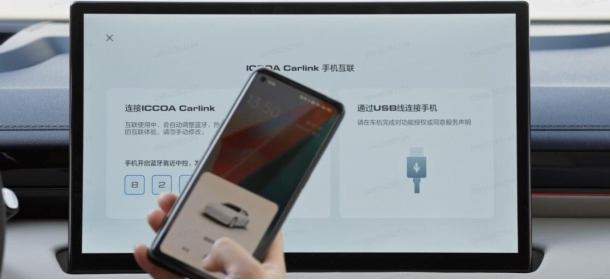
Amid the wave of automotive intelligence, the seamless integration between smartphones and in-vehicle systems has become a key metric for measuring the travel experience. Carlink, launched by the Smart Vehicle Connectivity Open Alliance (ICCOA), is a next-generation in-vehicle connectivity standard designed for the Android ecosystem, creating an open and interoperable smart bridge between automakers and smartphone manufacturers.
Carlink was initiated in September 2021 under the leadership of Xiaomi, OPPO, and vivo, and is jointly developed with leading automakers such as Changan, Geely, and SAIC. It brings together mobile-device partners, vehicle manufacturers, and supply-chain partners to create an open and unified mobile–vehicle connectivity ecosystem.
✅ Integrated Desktop Mode: Say goodbye to single-screen mirroring; your car system and mobile apps now run in parallel
The traditional screen mirroring mode has a prominent drawback: once connected, the vehicle's infotainment screen is completely covered by the smartphone display, preventing users from simultaneously operating in-car functions such as the air conditioner and native vehicle applications; the two services thus compete for screen space.
ICCOA Carlink innovatively introduces a hybrid desktop mode, adhering to a lightweight and bidirectional design philosophy: both the mobile app and the vehicle's native applications can be displayed simultaneously on the vehicle's dashboard; the app icon styles and categorization logic are defined autonomously by the vehicle system, without disrupting the user's existing interaction habits. The number of applications that can be loaded upon entering the vehicle is managed by the vehicle system to prevent application conflicts, truly enabling vehicle services + and the mobile ecosystem to share a single center console screen, leveraging the capabilities of mobile apps, hardware, and data to reduce the application adaptation and development costs for automakers.
✅ Continuous Iteration: Small windows, application workflows, and seamless file integration—the future looks promising
ICCOA Carlink is positioned to establish a unified standard rather than to lock in a specific product form; within this common framework, it enables differentiated implementation by different manufacturers, fostering collaborative development across multiple stakeholders and allowing a wide variety of user experiences to flourish.
Several key capabilities will also be rolled out in the future:
· Window Fusion: Mini-window mode — in-car applications support seamless switching and dragging between full-screen and mini-window modes;
· Application notification workflow: The background application remains active; after entering the vehicle, you can choose to continue the session on the in-vehicle infotainment system;
· Cross-device file transfer for in-car infotainment systems: instant transfer of images, videos, and other files across devices.
In the long term, the alliance will also focus on the hand-car mutual integration scenario to advance the adaptation of large AI models and the upgrade of the multi-device discovery and connectivity framework agreement. Leveraging a unified mutual integration standard, it will establish a smart service foundation for hand-car integration, enable service orchestration across brands and devices, and support intelligent mobility services across all scenarios.
✅ DK2.0 Digital Car Key Standard: Addressing the Challenge of Industry Fragmentation
Digital keys have become standard equipment in smart vehicles; China's installation rate for digital keys in new vehicles ranks first globally, and it is projected that by 2030 the installation rate for digital keys in passenger vehicles will exceed 80%. However, the industry has long faced challenges, including a proliferation of proprietary protocols, high integration costs, and inconsistent levels of security and user experience.
In response to this situation, ICCOA has introduced the DK2.0 Digital Car Key Standard to provide the industry with a unified solution:
· Comprehensive features: supports Bluetooth and NFC car keys, vehicle control, car keys for watches/wristbands, remote access upon vehicle departure, and key sharing;
· Safe and reliable: employs an asymmetric key scheme;
· Developer-friendly: Simplify integration workflows and improve development efficiency;
· Stable and low power consumption: Background cleanup and anomalies in the automaker's app will not affect key usage;
· High scalability: Built-in UWB/HADM scalability support and key sharing capability.
DK2.0 eliminates the need for automakers to engage in separate coordination with each mobile phone manufacturer, significantly reducing the burden of development and adaptation; it represents a crucial step toward the standardization of digital keys.
Carlink is more than just a simple screen mirroring tool; it is a future-oriented standard for the integration of smartphones and vehicles. As capabilities such as desktop integration, small-window session switching, and DK2.0 digital keys continue to be implemented, barriers between smartphones and vehicles across different brands will gradually be eliminated, delivering users a smoother and more unified smart mobility experience.
If you have certification or standard consultation needs related to ICCOA Carlink or DK2.0 digital keys, please feel free to contact Zhongle Certification. We have a professional automotive electronics certification team that can provide comprehensive services covering standard interpretation, testing, and the entire certification process.
Tel: 13417442373(Wechat)
E-mail: finny.zhou@zhongletest.com
Teams:nancy.le@zhongletest.com