


Over the past few years, the role of cybersecurity in the automotive industry has undergone a subtle yet fundamental shift. It was once a check item considered only at the very last moment before a vehicle model was launched; today, it has become an indispensable prerequisite for market access approvals, regulatory certification, and even overseas exports. Penetration testing, the method most closely aligned with the perspective of real-world attacks, is evolving from a "manual task" carried out by a small number of experts into a step that must be managed through engineering processes throughout the entire vehicle delivery workflow.
I. The Essence of Penetration Testing: It involves the simulation of authorized attacks, rather than tool-based scanning.
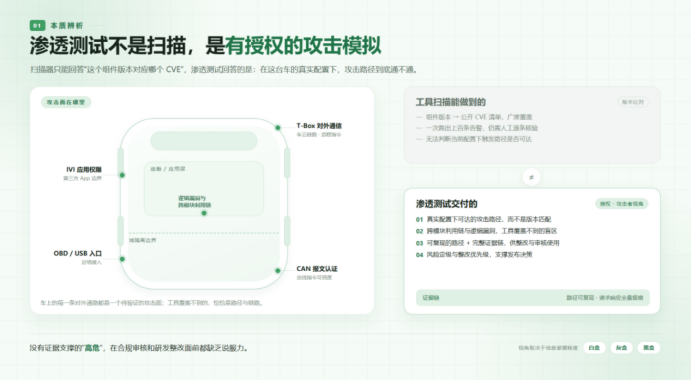
Penetration testing involves simulating authorized attacks; its core principle is to think like a real attacker. A scanner can tell you that "this component version corresponds to a particular CVE," but it cannot determine whether the exploitation path would actually be reachable given the current vehicle configuration. Precisely what tools cannot detect are logical vulnerabilities and exploitation chains that span multiple modules.
The attack surface in automotive contexts is very specific: external communications via the T-Box, domain isolation, IVI application permissions, near-field access points such as OBD and USB, and CAN message authentication. The testing approaches—white-box, gray-box, and black-box—depend on the extent of information available. The output is not a single figure representing the "number of high-risk vulnerabilities," but rather individual, reproducible attack paths and the corresponding chains of evidence. A "high-risk" finding unsupported by evidence lacks persuasiveness in both compliance audits and R&D remediation efforts.
II. Why has penetration testing shifted from being an "optional" activity to a "mandatory" one?
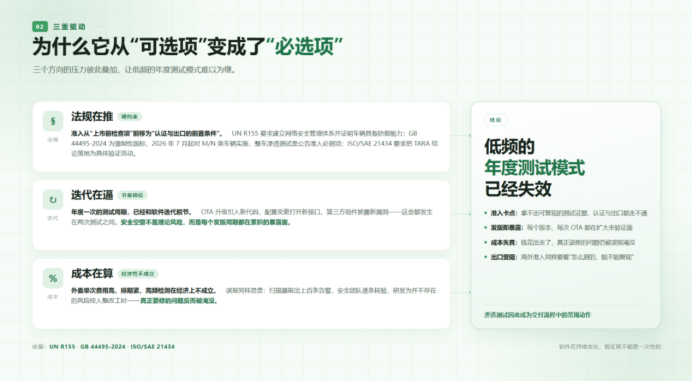
The driving force stems from three levels that overlap and reinforce one another, making the low-frequency annual testing model unsustainable. The driving force stems from three levels that overlap and reinforce one another.
Regulatory developments: UN R155 requires manufacturers to establish a cybersecurity management system and demonstrate that vehicles possess defensive capabilities; penetration testing is the core verification method. In China, GB 44495-2024, as a mandatory national standard, will be enforced for Category M and Category N vehicles starting in July 2026; penetration testing of the complete vehicle is a mandatory test required for market access under the announcement. ISO/SAE 21434 requires that the TARA conclusions be translated into specific verification activities.
Iteration is putting pressure: The annual testing cycle and software iterations have become decoupled. OTA updates introduce new code; configuration changes open up new interfaces; third-party components disclose new vulnerabilities—all of these events occur between two testing cycles. The security gap is not merely a theoretical risk: it represents an exposure surface that accumulates with every release cycle.
Costs are being calculated: The per-instance cost of outsourced services is high and the scheduling constraints are tight; therefore, high-frequency testing is not economically viable. False positives also lead to waste: the scanner generates hundreds of alerts, the security team verifies each one individually, and R&D invests effort in remediation for risks that do not actually exist, while the issues that truly need to be fixed get overshadowed.
III. Make penetration testing a sustainable engineering practice
The key lies in redefining the boundaries between people and tools: repetitive and standardized tasks should be automated, while experts should focus on logical vulnerabilities, deep exploitation, and risk classification.
Advance the detection window: Integrate the security pre-check into the build process: automatically trigger one round of detection once the new version's build is complete or before its OTA release. The detection of individual modules has been reduced from several weeks in the manual mode to the hour level; after fixes are applied, regression testing no longer requires queuing or waiting for a scheduled slot. When experts intervene at key milestones, they work with findings that have already undergone preliminary validation, rather than with the original alerts.
Individual verification of false positives: Each risk identified by the scan is verified separately. The results are categorized into only three types: the risk is indeed present (clearly describe how the attack could occur and provide supporting evidence); there is no risk (clearly explain the reasoning behind this assessment); or it is currently impossible to reach a definitive conclusion (clearly identify the missing information and assign the issue to the appropriate personnel for further review). For example, if the scan detects a high-risk vulnerability in OpenSSL and the issue can be reliably reproduced in a dedicated testing environment, it is classified as an actual risk. If, however, the version of libcurl matches the one in question but the device does not use the affected functionality at all and no issue can be detected through testing, the issue is initially marked as "currently impossible to reach a definitive conclusion" and corrective action is not immediately initiated. This approach allows human resources to be prioritized for issues that truly pose a risk.
Evidence retention: During the R155 and GB 44495 audits, auditors do not merely check whether you have conducted tests; they place greater emphasis on how the tests were performed and whether the issues can be reproduced. Keep every test record intact and associate test results with every anticipated security risk: for risks that are indeed present, retain records demonstrating how the issue can be reproduced; for cases where the protective measures work, retain records showing successful interception; for cases where it is currently impossible to determine the outcome, clearly state the reason. During the audit, present these records directly to the auditors—there is no need to compile them hastily or provide verbal explanations.
The boundaries must also be clearly defined: deficiencies in business logic, deep-layer exploitation chains, risk classification, and release decision-making still depend on senior engineers; automation cannot replace human judgment.
IV. Zhongle Certification: Providing actionable testing support along the compliance pathway
As penetration testing shifts from a project-based approach to a routine practice, the criteria for selecting service providers have also changed: the focus is no longer solely on whether the provider understands the relevant regulations; instead, greater emphasis is placed on whether the provider possesses the engineering capabilities to standardize testing procedures and ensure that the chain of evidence is complete.
Zhongle Certification offers penetration testing services covering multiple product categories. Its methodology follows the complete process—from information gathering and threat modeling to vulnerability verification and report generation. For smart vehicle applications, we can help vehicle manufacturers and Tier 1 suppliers integrate penetration testing into R&D and delivery stages, completing the closed-loop process—from test execution to evidence archiving—in accordance with the UN R155, ISO/SAE 21434, and GB 44495 frameworks. For teams currently establishing their verification systems, a partner who understands the principles of "test reproducibility and traceable conclusions" offers greater long-term value than a report listing the number of high-risk vulnerabilities.
Tel: 13417442373(Wechat)
E-mail: finny.zhou@zhongletest.com
Teams:nancy.le@zhongletest.com