




Ⅰ. Unveiling GAS Certification: More Than Just the "Google All-in-One Solution for Vehicles"
GAS, short for Google Automotive Services, is a comprehensive suite of applications and services developed by Google for in-car infotainment systems based on the Android Automotive OS (AAOS). The GAS certification is an official compliance framework established by Google for vehicle systems integrating GAS; automakers must obtain this certification to pre-install GAS services in production vehicles and launch them legally.
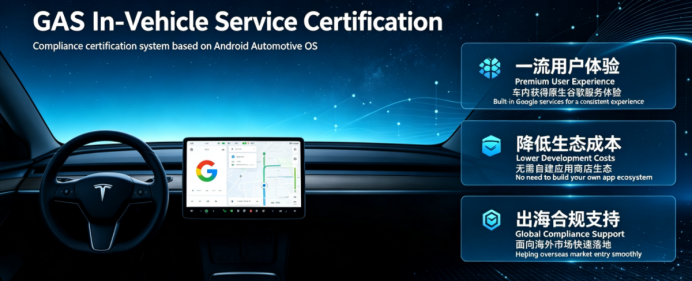
The core value of GAS is primarily reflected in three aspects: providing a world-class user experience, enabling users to access native Google services within the vehicle that are consistent with those on their smartphones; reducing maintenance costs for automakers 'application ecosystems without the need to build their own app stores; and assisting China-based automakers in overcoming cultural adaptation challenges when expanding overseas, leveraging Google's localized service capabilities to rapidly enter international markets.
Ⅱ、The underlying logic of GAS certification: the inevitable evolution from a "bonus feature" to a "mandatory requirement"
In mainstream markets such as Europe and America, users have widely embraced the concept that "cars should natively integrate Google services." The absence of GAS certification prevents vehicles from running core Google applications, directly impacting product competitiveness and consumer purchasing intent. Particularly in an era where smart cockpits have become a key selling point, whether a vehicle comes with built-in Google features often determines users' purchase decisions.
GAS is not merely an application suite, but a robust platform spanning the entire vehicle lifecycle. It defines a clear evolution roadmap for products and delivers consistently safe, seamless, and continuously upgraded mobility experiences to users via OTA updates. For automakers, obtaining GAS certification serves as both a testament to technical excellence and a strategic move to integrate into the global smart supply chain and build long-term competitive advantages.
From the perspective of market evolution, GAS certification has evolved from a "plus feature" for high-end vehicles to a "must-have requirement" for entering international markets. For China's new energy vehicle manufacturers aiming to expand their presence in overseas markets such as Europe and Southeast Asia, GAS certification has become a critical prerequisite for ensuring successful market penetration.
Ⅲ、From Zero to Gas Certification: A Comprehensive Practical Guide and Breakdown of Key Elements
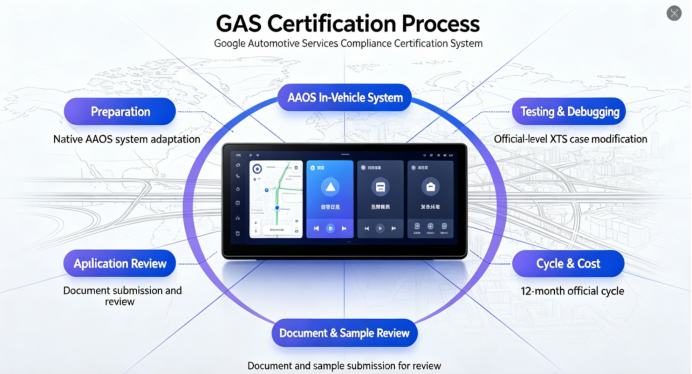
The GAS certification is conducted through the AAOS Vehicle Systems program, featuring high entry barriers, stringent procedures, and lengthy timelines, with exceptionally rigorous requirements for corporate technical capabilities and testing standards. The entire process comprises four key phases:
1. Pre-development Preparation
2. The product must be developed using Google's native Android Automotive OS (AAOS) and is incompatible with other in-vehicle systems. It requires customized hardware and software adaptation according to Google standards, which forms the foundation for successful certification.
3. Core Testing and Debugging
4. This phase represents the most time-consuming and technically demanding stage of certification, requiring comprehensive compliance validation of all system functionalities along with multiple rounds of iterative optimization. Enterprises must establish dedicated professional testing environments, conduct continuous debugging and refinement, and thoroughly verify the stability of both software and hardware components, imposing stringent demands on their R&D technical capabilities.
5. Official Application Review
After passing self-assessment, compile the complete set of documentation and prototype samples for Google review. The compliance level of these materials directly impacts project progress; any issues identified must be addressed through repeated adjustments until full compliance is achieved.
6. Periods and Costs
Google's official approval cycle is 12 months; the total cost ranges in the millions, covering testing and debugging fees, plus a separate Google system license fee.
IV. Zhongle Certification: A professional service partner specializing in GAS certification services
Zhongle Certification specializes in intelligent vehicle certification, offering mature GAS full-process service capabilities and comprehensive end-to-end support from development to certification. Leveraging three key strengths—advanced technical guidance, professional testing resources, and direct access to Google's review channels—it efficiently addresses compliance challenges and shortens certification timelines, striving to become a leading intelligent driving certification provider that empowers automakers in meeting global regulatory requirements.
Tel: 13417442373(Wechat)
E-mail: finny.zhou@zhongletest.com
Teams:nancy.le@zhongletest.com